
The key to a limitless mind is already in your mind.
On this blog, we provide the mindset tools, affirmations, and wisdom to help you turn that key.
Explore Articles

083: 6 Ways to Save Time in Your Business with Squarespace Scheduling
6 Ways to Save Time in Your Business with Squarespace Scheduling
Workflows. Processes. Systems.
Making the most of these will surely help you save time and streamline your business. But what if you can use a tool that not only saves you time but also opens up a streamlined way to generate new revenue in your business?
Enter Squarespace Scheduling.
Workflows. Processes. Systems.
Making the most of these will surely help you save time and streamline your business. But what if you can use a tool that not only saves you time but also opens up a streamlined way to generate new revenue in your business?
Enter Squarespace Scheduling.
As you may know Squarespace Scheduling is an app that’s integrated with Squarespace and I want to show you a few ways you can optimize it for your business. Those of you who are using Acuity Scheduling, this applies to you as well.
1. Book Complimentary Client Acquisition / Consultation Calls
After a potential client fills out an inquiry form to work with me, I invite them to book a complimentary consultation call. I have my availability set up there beforehand and clients can see which times and dates work for them. If I am in talks with the client via email and we agree on a date and time, I simply send an invite to them directly from the scheduling app by simply adding in their name and email and date of appointment. Since I have zoom integrated with scheduling, I can save time by not having to create or schedule meeting in there. Plus, clients get an automated email with link, date and time all in one.
I email my clients this link: https://sophiaojha.com/book-your-consult-call
It looks like the image you see on the right.
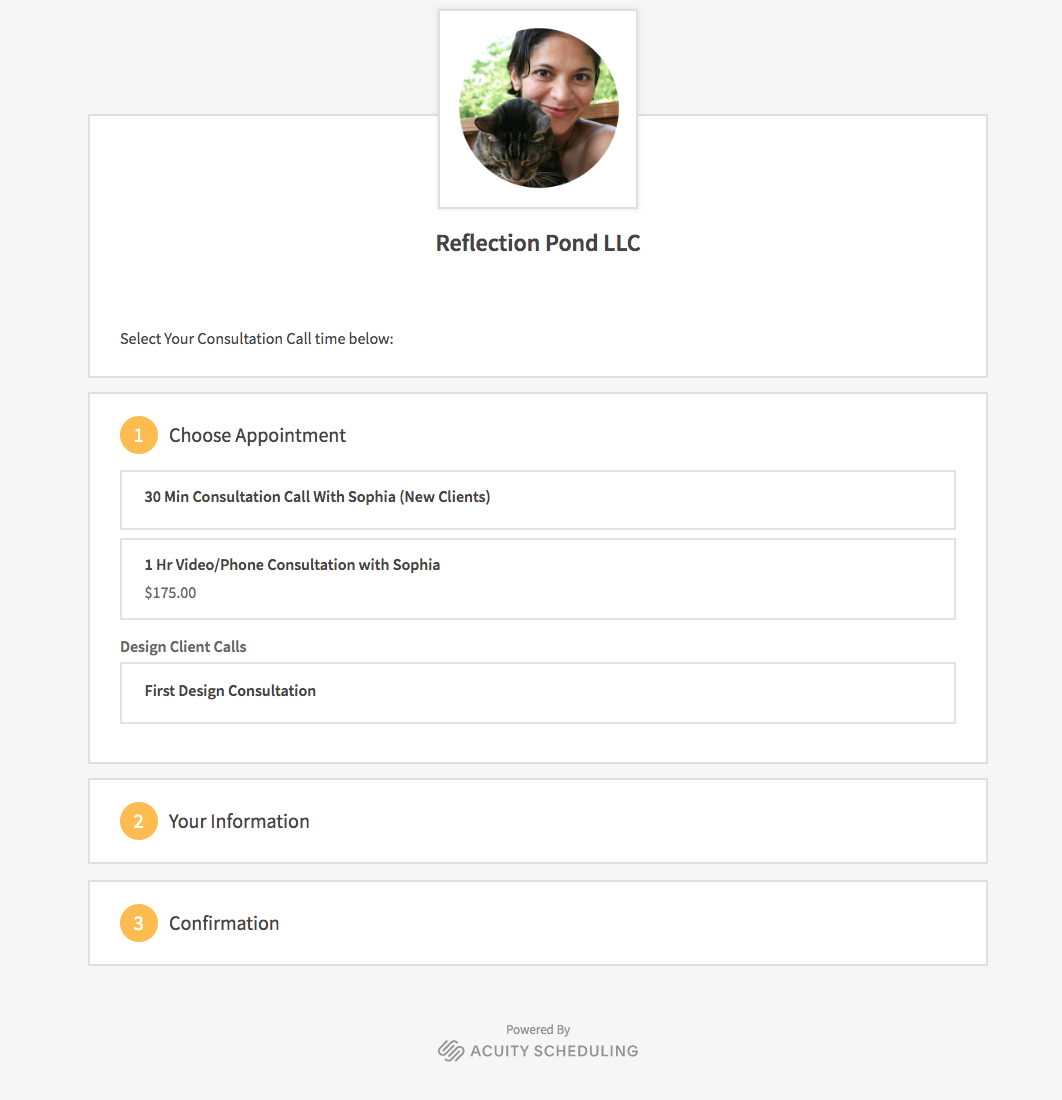
Click the image to go see the direct link live.
2. Book Paid Consultations
I don’t use this so often myself yet because clients often purchase a package with me which includes both implementation time as well as video consults and so I play it by ear and send them a zoom link for our meetings. But I have it set up just incase clients wanted to book right away. So if you wanted to block off set number of hours each week for paid consultations, this would work really well. Again it is all integrated with zoom and you preset your availability in the Scheduling calendar.
3. Book a Room or Facility
This is perfect if you have a facility where you book out different areas. I recently set up scheduling for a Canine Learning Center where their clients can book an indoor diving pool, a training course area and an outdoor pool.
Because of Covid, the owner needs time after each booking to block of half an hour for disinfecting the area and so that can be set up as well so no one can book in that half hour window right after another one client. That’s a super detailed feature that Squarespace Scheduling/Acuity provides and has come in really handy for this client.
You can go see the example live here: https://www.ink9lc.com/


4. Sell Online Zoom Yoga Sessions
Another client of mine is a yoga studio Canada who had to move everything online. Because of the nifty integration with Zoom, yoga studios can create an entire online calendar with all their varied class offerings. Yoga students can select the class they want to join, pay online and get an automated email with their unique zoom link.
The unique zoom link makes sure that only those who have paid can join the event. Plus, the Yoga Studio can creating a waiting room in their overall Zoom settings to admit only those who are on their list, for added privacy/security needs.

This is what the calendar looks like with all the weekly sessions. Check it out live: https://www.jadayoga.com/online
5. Sell Class Cards or Monthly Passes
Another feature of the Scheduling integration is that you can sell Class Cards or Monthly Passes. So for a yoga or fitness studio, this comes in handy. Let’s say the yoga studio offers Hatha Yoga, Iyengar Yoga, Vinyasa Yoga and Kundalini Yoga classes offer by different teachers. Then, they can set up a monthly pass or a weekly pass so that students can pay in advance and select from the different class offerings. Inside Scheduling, you can set up the limit based on the number of classes or the total amount. For example, you can select whether you want to have say 25 classes included in the Monthly Pass or allow students to select as many classes as they like until the value of $125. The app will keep track and once they hit the limit in the Monthly Pass, the students cannot book any more classes. You can also allow for a rollover to the next month of unused time or money. Pretty cool feature!

Check it out at: https://www.jadayoga.com/online
6. Design Consultation and Check-ins with Clients
During my two week design workflow, I meet with my clients on Zoom multiple times. We start off with a first Design Consultation on the first day and we wrap up with a Launch + Training Call on the last day. And in between these two sessions, we can meet spontaneously for quick 10 minute check-ins to review something or clarify a question. For my design clients, I simply email them a Zoom link that can be used repeatedly. But the first and the last consultations are booked via the scheduling app so that they can select a time that fits best for them.
I hope these are some good ideas for you that can help save you time, easily receive payments and streamline your workflow. Let me know if you use this already in your business and what questions you have run into.
Peace,
Sophia

082: How to Open A Free Trial on Squarespace - the Exact Steps Demo
How to Start A Free Trial On Squarespace
It’s important that you get a feel of the website building platform before you go ahead and hire a designer or start building your website yourself. So how do you do that? Start with a 14 day free trial. You won’t need a credit card. Just an email address.
So here’s how.
There are at least 5 good reasons why I think so:
It’s important that you get a feel of the website building platform before you go ahead and hire a designer or start building your website yourself. So how do you do that? Start with a 14 day free trial. You won’t need a credit card. Just an email address.
So here’s how to get started with a new a trial account.
Watch the video or read the article below it.
1| Click on my 14 Day Free Trial Link
Now, if you like my free videos and the help I am providing, you can use my affiliate link to start your account. I will get a little something only if you choose to purchase a plan but it will cost you nothing. So consider starting a trial site from here:
14 Day Free Trial for US residents:
https://www.sophiaojha.com/squarespace-us
14 Day Free Trial of International Residents (Non-US):
https://www.sophiaojha.com/squarespace-world
Alright, now you will land on the Squarespace website. Click on “Get Started”.
2 | Now you go to Templates.
You can either click on one of the categories on the left as your starting point. Or preview the templates here.
Now as of July 2020, what you see here are all Squarespace 7.1 templates. There really is no difference between these templates in terms of what they can technically do. So if you start with any of the templates here and want to create the exact about page layout that is on a particular template, you can do it on any other other 7.1 template. They are all different starting points and you can create what you want with ease. Think of templates as your easy starting points not set-in-stone endpoints.
Just a note, if you know and heard about Squarespace 7.0, the predecessor of 7.1, you can find all those templates down at the bottom of the templates page. Look for the link saying “Looking for earlier versions? Click here” or something along those lines.
Now, when I build new websites I still build them on 7.0 and so do many of my colleagues only because we have found a certain list of things that are better done in 7.0 than in 7.1. But if you are a DIY’er and want to put up a website fast, don’t worry about 7.0. You can choose a 7.1 template. If you plan to hire a designer, know that they may still want to build your site on 7.0 and that’s because they can do a lot more design wise without having to resort to coding.
Alright, so now you pick your 7.1 template or your 7.0 (earlier version) template.
And then follow the directions.
Al’right so that’s it. That’s how you open up your brand new website account on Squarespace. Go ahead and start building your first page on your Squarespace site. And again if you like the free content I am putting out here, consider opening a trial account through my affiliate links (see above). And I thank you a ton for doing so.
Bye for now and see you in the next video!
Al’right, so what’s the next step?
1 | Sign up for my workshop Squarespace Fundamentals
In this 90 minute workshop, I show you how to navigate your new Squarespace website. You will learn how to create a new page, add text and photos and understand how to use the different content blocks. This is a training of the 7.1 version of Squarespace.
See all details of the workshop here.
Get Started on Your Dream!
Start your Squarespace website and let me know how it is coming along. Drop me a line in the comments and share with me what your business is and what you want to create.
Peace,
Sophia

081: 5 Reasons Why I Love Squarespace: The Best Website Builder for Online Entrepreneurs
5 Reasons Why Squarespace Is the Best Website Builder Out There for Online Entrepreneurs
As you might have guessed, as a Web Designer who specialized on Squarespace websites, I am a big proponent of Squarespace for building your online presence. If you are an entrepreneur of any kind - whether you are an author, an artist, or a creator or if you are someone who has an idea, someone who wants to inspire and impact positive change, Squarespace is your platform - the best platform in my opinion and experience.
There are at least 5 good reasons why I think so:
As you might have guessed, as a Web Designer who specialized on Squarespace websites, I am a big proponent of Squarespace for building your online presence. If you are an entrepreneur of any kind - whether you are an author, an artist, or a creator or if you are someone who has an idea, someone who wants to inspire and impact positive change, Squarespace is your platform - the best platform in my opinion and experience.
There are at least 5 good reasons why I think so.
Watch the Video below or Read the Text

1. Squarespace was designed for DIY’ers. (Do-It-Yourself)
Squarespace was designed with you in mind - you, the creative business person and not for designers or developers. You are in the foreground of everything they do. In fact, that’s why they have over 80 professionally designed templates for a variety of niches so that you can pick any one of them and be off to the races. In fact, the newest version, Squarespace 7.1 had made it even easier for DIY’ers to build their website by making it more streamlined and user-friendly.
2. Squarespace customer service and help line
My experience of Squarespace support has been exceptional. You get a lightning fast response and the team is highly skilled not only in the topic but also in customer service skills. I’ve reached out to them and there has n’t been any issues that was not resolved. Having a professional team that is there to support you with your questions and helps you troubleshoot is priceless. Plus, there is a huge online collection of guides and video tutorials that their team has published that will be a good starting point for resolving your questions. Their knowledge base articles are detailed and highly useful and I have myself used them a lot.
3. Squarespace has a community behind it.
What do I mean by a community? There’s a community of web designers, web developers and bloggers who have put out tons of useful content on their blogs. They have created tons of video tutorials on YouTube and they have created workshops, programs and online courses. These are all packed in value and offer a huge resource at 4 am in the morning when an idea hits you and you want to run to your computer to implement it. This is important because it shows that Squarespace has already been tried and tested by thousands of users. And they are testament to the value Squarespace provides. See a directory of Squarespace Designers put together by my colleague Erin Neumann here: https://www.bealignedwebdesign.com/best-squarespace-web-designers
4. No coding, no design experience needed.
As I mentioned in point one, Squarespace is geared towards the non-designer. So you can create a highly professional website just by using their templates as a starting point. That means you do not need to know any HTML or CSS nor do you need a design-eye. Just switch out the template photos and content and you have a website that looks stunning and can get you started. This is the first barrier that is removed. Of course, you can do a lot to move away from the template and make it look more unique and fresh. But that can always be done in phase 2. It is so important to get started building your SEO (Search Engine Optimization) with your content and blogs. So my recommendation to you is just go and build your 5 most important pages and then you can tweak the design and make it all cool gradually.
5. It’s an all-in-one platform.
This is a really important point. Running an online business means there’s so much to think about and take care of. Then on top of that if you have a gazillion apps and third party integrations, then it just makes your business life very dense and complicated. And you didn’t get into business for more complication, I am guessing, but rather for optimizing your time, streamlining and powering up your life…to make an impact and grow your revenue, not to sort through hundred million different apps, right? That’s why Squarespace is really useful because you can do everything in one place: grow your email list, send out weekly newsletters, sell your services, sell your digital/physical products, demonstrate your expertise via a blog or podcast, host your online course, schedule free discovery calls with potential clients, sell paid consultations, run your website analytics, and so on and so forth. It’s all here in one place.
I run to websites on Squarespace, one you are on right now: sophiaojha.com for my web design business and the other for my site about mindfulness and meditation: reflectionpond.com which is the reason I got into online marketing and web design (I wanted to learn how to promote my meditation programs and that’s how I got into learning about web design…if you want to know more about that journey, see my Manifesto page).
Al’right, so what’s the next step?
Take it for a Test Drive.
Take it for a Test Drive. Just like you can take a car for a test drive, you can try out Squarespace for free. No credit card needed. Select your location below and start a free trial and play around with it. I will be posting more videos to show you how to create your first page on Squarespace so look out for that. Try it before you buy it!
14 Day Free Trial for US residents:
https://www.sophiaojha.com/squarespace-us
14 Day Free Trial of International Residents (Non-US):
https://www.sophiaojha.com/squarespace-world
Get Started on Your Dream!
Start your Squarespace website and let me know how it is coming along. Drop me a line in the comments and share with me what your business is and what you want to create.
Peace,
Sophia
080: How to Remove Background from Photos using Canva
In this video tutorial, I take just over 5 minutes to show you how to remove background from your photos using an app called Canva. Also get the complimentary link to try Canva Pro for 30 days!
First of all, I am so excited to restart my content creation for 2020! After the first two quarters of very busy client projects, I am back to creating new content for you.
In this video tutorial, I take just over 5 minutes to show you how to remove background from your photos using an app called Canva.
Show Me Your Work!
I love to see what you create. So drop in a link to your creation in the commetns below and let me see how you’ve used the instructions in this video,
Peace,
Sophia

079: The First Two Steps To Creating Leveraged Passive Income With Digital Products
Let’s begin with a pop-quiz!
Pop-Quiz: If you want to create a passive income stream with digital products, which of the following do you think would be your first two steps?
Pick from the following options…
Let’s begin with a pop-quiz!
Pop-Quiz: If you want to create a passive income stream with digital products, which of the following do you think would be your first two steps?
Drafting an outline of your online course
Deciding which format your digital product should take (audio, video, course, membership, etc)
Break writer’s block by just start writing your first chapter of your course
Review which online course platforms are the best for your business?List of equipment you need to buy for creating your digital product
Which third-party integrations will you need on your Squarespace website for selling your course?
Figure out how to price your digital product
Should you go on launch mode or evergreen it?
Yes, you will need do invest time and thought into these areas before you create your digital product. But none of these makes up the first two steps. Before you do any of the above steps, you first need to 1. find out what problems your own clients are asking you to solve for them and 2. find out if someone will pay for your digital product.
Step 1: Figure out what solutions my clients want
Step 2: Find out if someone will pay for your digital product
Let’s dive into each of these one by one.

Step 1: Find out what your clients want
You see, you have so much to teach and share that you could probably begin drafting an outline for an online course in a single afternoon, if you really wanted to. But what I found out from my year and half of online course making adventure several years ago is that, as much as you need to teach what you know, you also need to align it with what the market wants. I am not saying that the thing you want to make needs to be already have existed because with that logic the light bulb would never have been invented, nor would have the airplane. Or any of the millions of new innovations that continuously come into being. But they all came into being because there was a need for it, a yearning for it in some form or the other. The end result or the product that you create doesn’t necessarily need to be existing previously. But the problem that your product solves, now that, that does need to be existing previously.
The end result or the product that you create doesn’t necessarily need to be existing previously.
But the problem that your product solves needs to be existing previously.
So when it comes to creating your first online course, it is important that you know what problems exist. And more importantly, what problems your own paying clients are asking you to solve. That information is evident in the kind of things people are paying you for because a service provide you are closely aware of what you are getting hired for. This not only will help you for example to create a customized service package but it is very useful for another reason. And that’s this: if there are folks who are paying you for a custom solution, then there are surely multiple others who want that as well but cannot ask for a customized solution for it. That’s where you can create leverage with a leveraged product.
Example 1: For example, let’s take the example of a web designer, named Sophia (…see my head nodding). For every one person who hires me to custom design their website there are many others who are learning how to build their own site DIY (Do-It-Yourself) style. So if you are web designer, can you think of a solution that serves the DIY people and can instantly leverage your time and efforts? Perhaps, a 4-week mastermind to build their website or an online course that walks them through each part of the website building process. Now, you can serve a lot more people and you have leveraged your time and efforts while increasing the business’ bottomline.
Example 2: Take another example: a programmer, named Alex, who is hired to create high-end custom code for individuals. How about a portfolio of standard code products that are at a lower price point than the custom solution but can be used by more than one person. Instant leverage!
Example 3: Or think of a master hand lettering artist, named Shawna, who gets commissioned by big corporations to come in and create hand made unique art on large walls in their lobby. She can think of teaching other hand-lettering artists on how to get commissioned by big corporates. This could be a six month online coaching program that may even be a high-end offer but has instantly leveraged her time, while attracting very serious artists who want to take their art career to the next level. And it’s all digital with pre-recorded sessions interspersed with some live laser coaching.
Example 4: A piano teacher, named Robin, does live three-week group courses to teach beginners how to play the piano. They then move on to an intermediate course where they have established themselves further in their piano skills. Now she knows that she has students who love her teaching style and have already come to her for beginner and intermediate group courses. She knows they are hungry to get good at their craft with HER help. This is where the digital product leverage kicks in: she can create a VIP three-month deep immersion course to help build up their repertoire. This immersion course could be designed as an online course with three modules over three months. Each month they master one module, with a video per week that contains short weekly assignments to complete/practice. At the end of each month, they come together in a live zoom meeting to ask questions and to demonstrate how far they have come with their skills. And they repeat this for each module. At the end, they have three distinct pieces mastered, say one from Bach, one from Mozart and one from Beethoven. Or let’s say the whole three months is about Bach and then the can go to Mozart in yet another three month program and then Beethoven in another three month program. And now you have a 9 month immersion program! This could even evolve into high-end in-person retreat type offering eventually.
Now do you can see what I mean? We need to understand what we are already being paid to create and then extrapolate from there. Take whatever you are already doing for your current clients who are paying you big bucks to do it and then think of how you can translate that into a digital product that can be purchased by a lot more people, thus, leveraging your time (you make the thing once) and generate on-going revenue from it (launch it or do it evergreen).
Actionable Task 1: Take Inventory of Your Past Client Projects
So alright, you may ask, ”What is the actionable step from this?” Well, the actionable step is to answer this question: What are your clients paying you for?” Take inventory. Make a list of past client projects that you got hired for. Then see what they look like. Now you if you are a business coach, you may say, “all my clients hired me to help their business get to the next level.” If you are web designer, you may say, “all my clients hired me to design websites”, or if you are a piano teacher you may say, “my students hired me to get good at their technique”. Okay, that’s a nice response. Perhaps I should specify and articulate my question better:
Q: What common thread do you see in the projects you got hired for in the last six months?
Maybe your coaching sessions were all about figuring out a niche, or on how to create a service package to attract clients.
Maybe your piano students were all self-learned students who now wanted to develop their technique, or some wanted to master reading music or they are mostly high-school students wanting to prepare to get into advanced music school.
Maybe you designed a string of websites for non-profits, or authors and coaches, or yoga and wellness instructors.
Action Step: Make a list of past client projects that you got hired for. And see what common thread you see in the projects you got hired for in the last six months. Circle, highlight, or underline similar projects and you will get your answer.
What to do if you don’t have paying clients yet?
Now, if you are at the start of your entrepreneurial journey, the main goal then is to get clients and get paid for your services. Digital products can come but they may not take center stage right away because you still need to validate your business and see if there’s any traction. An avenue for research for those just starting out is to see what people are writing in the comments of your own blogs or of your colleagues, what are they asking you on your social media channels or on others channels in your niche, and you can even search what questions people are asking on forums like Quora or Reddit or Facebook groups. Are there people wanting to pay for your particular service offering at all? You need that to happen first, right?
The bills gotta get paid and in my experience, the fastest way to create revenue from an online business is to offer a customized one-to-one service for clients. Now, if you create physical products, that’s a whole different ballgame and I have no experience in that area, so I will leave that topic for another expert to talk about. But what I do know from my own experience as an online business owner who started offering services first, is that when I got my first $90 to setup a ConvertKit account back in 2016 for my very first client (majorly underpriced, but hey it was a start), that’s when my business was born. Getting the revenue doing services for individual clients then created the momentum for me where I could then begin to think of leveraging.
The fastest way to create revenue from an online business is to offer
a customized one-to-one service for clients.
Are you on a hamster wheel of serving clients?
As satisfying as working with clients can be, it also made me realize that I was still trading hours for dollars. Nothing wrong with that, at all. But as soon as I was finished working for a client, I was back in client acquisitions-mode which often felt like starting from scratch. And I’d wonder if this is the point in the journey of a business owner that the thought aries, “How long can I sustain this? What if I could leverage my time and create new ways to generate passive income?” It certainly was for me.
Even a $1000/per month of passive income can mean a huge boost for any business that is under six figures. And that’s when we start dreaming of digitizing. Is that how you feel? Well, my friend, I know exactly how you feel. So if you don’t yet have paying clients, roll up your sleeves and get that first client. If you already have clients but feel you are stuck in the never-ending cycle of serving clients then working on acquiring clients, then serving clients and back again on the hamster wheel, I’d say try to find an outlet of time, a window of time, during the day when you plan your exit from this exhausting cycle. Yes, it’s great that you are running your own business and doing what you love but you also built your business for time-freedom not just money-freedom, right? So be patient while you are in it, but start scheming your digital leveraged product adventure at any free moment you get. Serve one-to-one clients now but keep in mind the big picture of where you want to go with your business and consider how serving one-to-many digitally can be a viable route for your entrepreneurial journey. Alright, now let’s continue with step no. 2.
Step 2: Find out if someone will pay for your digital product
Okay, so back to the steps you need to take for your leveraged digital product creation. Let’s say, you have identified your most common projects you got hired for. For the sake of example, let’s look at the piano teacher, Robin, who offers individual piano trainings. Now she does the actionable task from step 1 (see above) and finds out that 70% of her students are high school seniors wanting to prepare their college application audition video to get into music school. She still has a good percentage of self-learned adults who always wanted to learn piano from a trained instructor and that’s a good bulk of her clients. But the 70% of college-wannabes is a good segment that she can start thinking about specifically.
Robin could start strategizing what type of a digital product she should create for the 70% of her students who want to prep an audition video that shows their piano skills for their college application. Her digital product could be a summer intensive that students join during the summer before they begin college applications. It could be made up of modules in which she helps them to pick out the music pieces that they would include in their audition video, guides them on practice habits and how to create a schedule of practice, guides them on the right recording equipment they need, and all the way to finally recording the application video and getting it ready to send out come September.
An alternate approach would be for her to first create a series of live online workshops for each module. With a live audience you can tune in (no pun intended) to what the piano students are asking. Then after the live session are over, she can get back to her desk, review the recordings and then create clean video modules. By the way, this is exactly how I created my Host Your Online Course program in 2019. This approach turned out to have so much less pressure for me because now I could create the content as I went instead of having all the videos pre-recorded. Watch this video where I explain how and why I decided to take this route.
Now at this stage where she has come up with an idea for an online workshop or course, it can be tempting for Robin to jump into actually creating the digital program. But this is exactly what she should avoid. The next step would be to write up a sales page that articulates all that her program would contain. Now for me, I go straight to the backend of my Squarespace website and start creating the sales page. For some others, it may be best to take a notebook or open up a word/pages file on their computer and start writing. The idea here is to get the details on to paper and then on to your website. This also gives you an idea of how you want to price it because you see all the components of the offer laid out in front of you. Then, send an email to your students either individually or if you have built an email list, send an email to the people on your email list with an early bird invitation. Again, the format could be an online course or a series of live workshops.
You’ll notice, that at this stage, you have not created a single module. You are simply pre-selling your course/workshop before you create a single slide, any other digital component of it. The only thing you will have created is the sales page with the offer expressed in detail.
This method is not new and I am not the first one to be using it. I discovered it through my own trials and errors of course-creation, where I jumped right into creating a massive course and then painfully found out that there were no-takers. Pre-selling is an easier and much faster and low-risk way to find out if there’s traction for your idea. Create the sales page with an early-bird pricing offer and send it to your audience. If no one purchases, you need to get back to finding out what you need to change. It doesn’t mean that your idea was not useful or good, may be your audience is not big enough or your sales page was not impactful or you may need to tweak some other aspect of understanding what your audience wants. Once you have real people putting out real money for your offer, that’s when you have real evidence that what you are offering is wanted by your audience and it goes beyond just an interest in your offering.
Pre-selling is an easier way to find out if there’s traction for your idea.
Create the sales page with an early-bird pricing offer and send it to your audience.
Actionable Task 2: Validate your idea by pre-selling
After you’ve taken inventory of the common thread of hired projects in the last six months, think of what is the main challenge that your clients have asked your help for. Now, you can brainstorm a way to leverage that solution so that you can serve many people by creating something once. This could be a series of live group workshops as I hinted in the earlier section. But it could also be an online course. What’s important though is to see if someone will pay for it. And the way to find out is to make the offer to your audience (current clients or folks on your email list). Now if it will be an online course, make sure to plan your time wisely and clearly say on your sales page when the course will be released. And remember things often take longer than we had planned, so add in a good buffer of extra time.
Action Step: Write out what your digital product will consist of and what it will achieve for your clients. Create a pre-sell sales pages and add it to your website with early-bird pricing. Invite your your students individually or send the invitation to your email list.
How to create a pre-sell sales page
I think when people hear the term, “sales page”, they get a bit uncomfortable. First, because the idea of selling can be uncomfortable, and second they may not know what to put on a sales page. Now I should perhaps write another blog all about how to write and design a sales page, but for starters, let’s not complicate it. The sales page that you write to test your new product needs to have at least the following six things:
1. Tell clearly what the program/digital product will do for them: the benefits
2. Outline the different modules and what it contains: the features (videos, pdfs, action plans, worksheets, audios)
3. Note any timelines if it’s a live workshop, example: The program starts on July 15th. Early-bird ends on July 1st, etc.
4. Clearly state what it costs $$ and how they can purchase: purchase button, or by application.
5. What some other students have said: testimonials (if it is a first launch, add testimonials of your other trainings, services or offerings).
6. An official bio and a nice smiling photo of yours.
You can always embellish this but start with the basics and then build upon it. I have myself fallen in this trap of perfection. This really is a mental vice, not exaggerating here. To fall in the trap of perfection is a game of the ego that only causes you hurdles on your path to progress, under the guise that it only wants to make sure you look good to others. Dare to look bad, look imperfect: that’s better than not have anything created at all. (Okay, I am finished giving a pep talk, but more than you, it’s mostly likely, me who needs to hear this right now).
To fall in the trap of perfection is a game of the ego that only causes you hurdles on your path to progress, under the guise that it, the ego, only wants to make sure you look good to others.
Vanity ≠ Progress
Your path to creating leveraged passive income starts now
So I’ve outlined for you a possible path that you can take for creating your leveraged passive income. It’s now time for you to take action on it. It begins with first figuring out what kind of solutions your clients want, finding the common thread in the type of projects you were hired for, then translating that into a solution that will serve many in a leveraged way, and finally creating a sales page and inviting your potential and current clients to benefit from it.
Let me know in the comments what questions come up for you when you read this post and also share with me where in the passive income journey you are in right now.
Peace,
Sophia

Related:
073: Sell your course before creating it:
www.sophiaojha.com/blog/073-sell-your-course-before-creating-it
067: Three things you should know about doing a live workshop series
www.sophiaojha.com/blog/067-three-things-about-live-workshops
053: How to build a landing page on Squarespace for a "survey"
www.sophiaojha.com/blog/053-landing-page-on-squarespace
052: Do this One thing to get to know the real needs of your audience
www.sophiaojha.com/blog/052-ask-the-audience
031: How to Create an Evergreen Sales Funnel Using Visual Automation in ConvertKit
www.sophiaojha.com/blog/031-how-to-create-an-evergreen-sales-funnel-using-visual-automation-in-convertkit
Why rearrange your priorities?
During these days where the world seems to be grasped by the events surrounding COVID-19, the above quote from Ajahn Brahm makes a strong point. It’s not just death but the ongoing uncertainty and the realization of how things are impermanent that makes us reassess our priorities.
Banner Photo by Nikolay Zakharov on Unsplash
Why Rearrange Your Priorities?
“Insight into death rearranges your priorities.”
- Ajahn Brahm, British Monk living in Bodhinyana Monastery in Australia
During these days where the world seems to be grasped by the events surrounding COVID-19, the above quote from Ajahn Brahm makes a strong point. It’s not just death but the ongoing uncertainty and the realization of how things are impermanent that makes us reassess our priorities.
It’s not that this situation is unique to the spread of the virus. In fact, it was always like this. There was always uncertainty. There was always impermanence. There has always been death around us. But the current situation has simply underscored and highlighted these realities more than before. In fact, it has also brought into focus the stupidity and ignorance of us human beings, it has brought to the fore our own suppressed emotions which may have been residing in the deep recesses of our minds and hearts. Whatever was in the background, quietly hidden behind our blurred vision of our world and ourselves, has come starkly into view and has taken up residence front and center in our awareness.
So, what is it that we need to do?
Process Emotions
When feelings are arising in you, take that as a welcome opportunity to clean out old residue of unprocessed emotion. All that is required is: to acknowledge the emotion, notice it, and become aware of it. The task at hand may be simple but not easy. The emotion will slowly dissolve when you fully give it your attention and care. Not wanting it to go away, just allowing it to be and allowing it to fade way. Just like clouds arising in the blue sky. You watch them appear and slowly they disappear. The biggest hurdle you will create is to want to stop the emotion or want it to go away - in other words, resisting it instead of being present with it.
Process Things
As you stay at home more than normal due to the lock-downs or due to self-quarantine, you will be faced with your stuff even more. By stuff I mean things, objects, papers, furniture, decor, bedding, household items, books, jewelry, electronics, shoes and so on. This is a golden opportunity to let go of anything that has not served you well or has served you and is ready to move on. Things that you didn’t even notice before, now suddenly stand out because you are home more and see it more. Use this chance to assess what needs to go. Things hold energy and as you release them, you open up energetic channels within your body, within your home and even within your bank account to receive what is truly nourishing and uplifting for you. I remind myself this concept with a bookshelf metaphor: Let’s say I have a bookshelf filled to the brim with 50 books. But I want a 51st book that will truly serve me right now. I cannot put it on the bookshelf unless I make room for it and let go a book that has already served me. It is time to let go in order to make room for the new. A really good resource for decluttering things is this blog: Be More With Less
Process Time
By process time, I mean assessing what are the things that take up your time. Even without the virus amongst us, we are aware that we only have so much time on this earth. Sooner or later, our time shall come to shed this body and move on to a new life. So what are we doing with this life, with the time on our hands. Are we wasting it away on mindless social media? Are we spending it carelessly on that which is not wholesome and nourishing? We all do this in some form or another. How can you be vigilant of your time just like one would be of a tap that is endlessly running. We want to close that tap and conserve the precious resource of water. The same we want to do with the tap of time that we have left open. But first, we need to look at our day and see where the leakages are. The most common ones are social media and entertainment. For me, it is Facebook. I have tried to limit my time on FB but the habit has been set. My only option right now is to quit cold turkey. And today I will be sending a note to my friends that I will be ending my FB presence. I know that it will disconnect me from the life of many of my friends. But I’d rather have meaningful quality time with them via Facetime or Skype and eventually in person (after the quarantine and lock-down period is over, of course), than to superficially watch their life from afar. I want to plug those holes that are sucking out precious time away from that which truly matters to me.
Process Priorities
This one is linked to the process time bit. It may be easier to look closely at what your priorities are. If you have no idea what your priorities are, read this blog and do the exercise to find out what truly matters to you. Have your priorities written down on a piece of paper. I keep it in my journal and see it once or twice a week and sometimes every day. It serves as a guide to recalibrate my actions and my activities when I go off course. When one reminds oneself that we have limited time, and the events of our world bring that fact closer to our awareness, we start to reassess - what do I really want to do, how can I really be of use to others, how do I want to redesign and rearrange my time and my priorities.
When you invest the effort and the time in reassess the various areas of your life, you will find that there is much you can do to get in alignment with what’s in your heart, with what brings you true satisfaction and true fulfillment. It’s not an easy path and that is why so many people default to an un-assessed, mindless way of living. It takes time to reflect on our life, it takes courage to let go, it takes patience to see the benefits over time. It’s also not easy because we don’t see anyone in our life doing this and setting an example for us. So we go and seek out those who do. And they are out there. You can find them on the internet, you can find them in monasteries and nunneries, you can find them through books they have written or good deeds that they are doing. Find those that inspire you and then read their work, watch them speak, learn and implement what they teach so you can see for yourself if it makes sense and if it is of any value for your life.
Impermanence, uncertainty and death are part of life. Realizing and understanding them as characteristics of life, can help us live intentionally that gives meaning and fulfillment to us as we take courages steps to continuously reassess, reflect and make positive changes in our lives. It’s a gradual path and an ongoing process of change.
Much love and peace,
Sophia
PS: If you’d like to see the books that inspire me, see the books I love here.
*There are affiliate links on this site. When you purchase via such links, I will receive a small affiliate commission without any extra costs to you.
This article is part of a series called “What truly matters” - all about finding out what’s really important in your life and then finding time to do it EVERY DAY. See preceding articles in this series below:
Feb 11th The 4-day workweek: Why I choose to work only 4 days a week and you can too (You are reading it)
Feb 4th The process of finding out what's truly important
Jan 28th What decluttering your home shows you about the meditation process
Jan 21st: What to do with the uncanny feeling you feel in your stomach or in your body? What does it mean?
Now, it’s your turn to share:
Share with us how you are rearranging your priorities or sticking with what’s there.
I’d love to know so please share in the comments below.

Uplifting Audiobooks: A Collection
Audiobooks that Sophia and Cristof have volunteered to record for other authors.
Uplifting Audiobooks: A Collection
Banner Photo Source: Photo by Dedu Adrian on Unsplash
The year was 2017. I had just come back from my first 10-day Vipassana meditation retreat in Georgia, USA. It was there that I learnt about the non-profit publishing house, Pariyatti. I went online and found so many free and for pay books and audiobooks. I selected my first audiobook from there, The Art of Living from their online streaming platform. It was there that I saw a note that said, anyone who would like to volunteer to record these audiobooks please contact us here.
That’s how I got started. By now, we have recorded three audiobooks. And I just got the green light to record an audiobook for a work by Ayya Khema. I am super excited. I am happy to share them with you here:
Stream/Download: You can either stream the audios on the website itself. Once you click the link of the book below, you will see the streaming section. It will look like the screenshot on the right. You can play the audio right there.
Or click the three dots on the very right to download the audio.

Note: Descriptions have been copied from Pariyatti’s website.
1. Inspiration from Enlightened Nuns
Narrated by: Sophia Ojha Ensslin
“In this audiobook we will be exploring poems composed by the Arahat bhikkhunīs or enlightened Buddhist nuns of old, looking at these poems as springs of inspiration for contemporary Buddhists. Most of the poems we will consider come from the Therīgāthā, a small section of the vast Pali Canon. From the poems of the enlightened nuns of the Buddha’s time contemporary followers of the Noble Eightfold Path can receive a great deal of instruction, help and encouragement. These verses can assist us in developing morality, concentration and wisdom, the three sections of the path. With their aid we will be able to work more effectively towards eliminating our mental defilements and towards finding lasting peace and happiness.”
https://store.pariyatti.org/Inspiration-from-Enlightened-Nuns-br-audiobook_p_4982.html
2. The Elimination of Anger
Narrated by: Sophia Ojha Ensslin & Cristof Ensslin
“The Elimination of Anger, by Ven. K. Piyatissa Thera is a helpful manual highlighting methods that the Buddha taught to help understand and deal with anger. It also contains two stories retold from Buddhist texts, The Reviler and The Anger-eating Demon. This is an audiobook version of this booklet. It can also be found in the book Collected Bodhi Leaves Volume III.”
https://store.pariyatti.org/The-Elimination-of-Anger--MP3-Audiobook_p_5104.html
3. Mudita: The Buddha’s Teaching on Unselfish Joy
Narrated by: Sophia Ojha Ensslin
“This audiobook of Wheel Publicaton No. 170 contains several short essays, one by the editor, Ven. Nyanaponika, and three by lay practitioners on one of the lesser known and too-little practiced sublime states of mind. Mudita, usually translated "sympathetic joy," was designated one of the brahma-viharas by the Buddha, one of the sublime, noble states of mind. How is it to be practiced and what are the implications of mudita on the spiritual path? These essays address those questions. Stream the audio using the audio player below or download as multiple MP3s or a single, long MP3 file (Duration: 71 minutes).”
https://store.pariyatti.org/Mudita--MP3-Audiobook_p_4895.html
More Audiobooks:
Pariyatti has many other audiobooks that you can find here: https://store.pariyatti.org/audiobooks. And you can also see all their other materials here: pariyatti.org.
We hope you will find them useful and will find inspiration and peace while listening to them.
Love,
Sophia + Cristof
How to craft a mini-retreat at home?
Taking time off to go on a ten-day meditation retreat is a wonderful way to rejuvenate our tired minds from the hustle-bustle of our busy lives and to deepen one’s meditation experience. I have done this thrice in the last few years and have found immense benefits of shutting off from the world.
But a ten-day meditation retreat is not always feasible. Many people may not have the opportunity to take ten days off from work and be away from their kids and family. Or the idea of a ten-day meditation retreat sounds simply too daunting.
Banner Photo Source: Gaetano Cessati
How to Craft a Mini-Silent-Retreat at Home?
If you are doing a meditation practice weekly, that's already more than not doing any at all. A daily meditation anchors you even more smoothly to your habit of training the mind. It's the day-to-day maintenance to keep the weeds out and cultivate the roses of your garden. If you can bracket your day with a meditation in the morning and one in the evening, you are helping yourself even more. That's something we are working to make a habit of.
What's also helpful is a long retreat of three, five or ten days during which your sole purpose is to cleanse your mind, quiet the mind and go into the depths of your mind to dissolve the "defilements" of greed, hatred and delusion that lead to unwholesome thoughts, speech, and actions.
But when such a retreat is not feasible right away, a one day at-home mini-meditation retreat can come into play. You can do it yourself or with the help of a friend. This is exactly what we are doing this Sunday, starting with a mini-retreat for Cristof.
Three, Five, Ten Day Retreats
Taking time off to go on a ten-day meditation retreat is a wonderful way to rejuvenate our tired minds from the hustle-bustle of our busy lives and to deepen one’s meditation experience. I have done this thrice in the last few years and have found immense benefits of shutting off from the world.
But a ten-day meditation retreat is not always feasible. Many people may not have the opportunity to take ten days off from work and be away from their kids and family. Or the idea of a ten-day meditation retreat sounds simply too daunting. The costs are not necessarily a big factor because a lot of meditation retreats in the Buddhist tradition are donation-based, although traveling costs to those places may be a consideration. Or it could be that you have found a retreat center but it is full already or the next retreat date is months away. In any of those situations, a mini-retreat at home could be the answer.
What is the purpose of a mini-retreat?
A mini-retreat is time spent in meditation and introspection at home with the goal of withdrawing yourself from the daily activities and obligations and taking time to go inwards. It gives your mind and body the time and space to recharge. It allows you to decompress, process open emotional issues, and to be the witness to what’s going on. A mini-retreat can also help you take a breather after an intense period in your life - whether from a busy period at work or an emotional challenge or physical illness that you just had to tackle in recent weeks. Such mini-retreats sprinkled into your schedule can be very helpful to do throughout the year.
How to do a mini-retreat?
The mini-retreat can be crafted in a variety of ways to suit your specific needs and time availability. It can be laid out as a three-day retreat or a one day program or half a day session. Obviously, a three-day retreat allows you ample time to go deep in your practice while a half a day session is a quick dip into your inner-world and a day program can allow you just enough time to mix in a few different introspective exercises. Think of the half-day retreat as the essential building block. You can then repeat it twice to make the one-day retreat. And then use it again to carve out a three-day retreat schedule. See my example below:
The Half-Day Retreat Schedule
The Day Retreat Schedule
The 3-Day Retreat Schedule
Morning
Breakfast
Meditation
Reading
Watching a Monk/Nun talk on a Buddhist idea
Meditation
Morning
Breakfast
Meditation
Reading
Watching a Monk/Nun talk on a Buddhist idea
Meditation
Lunch
Afternoon
Walk
Meditation
Reading
Watching a Monk/Nun talk on a Buddhist idea
Meditation
Dinner
Repeat the Day-Retreat Schedule on three consecutive days. Alternatively,
Day 1 : Half Day Retreat Schedule
Day 2: Day Retreat Schedule
Day 3: Half-Day Retreat Schedule
* Note: Keeping noble silence is very helpful to quiet the mind. If you need assistance or need to convey an important matter for logistics of your retreat to your family, you may of course speak (but as minimally as possible).
As you can see, the main components of the retreat include:
1. Time for Meditation
2. Time for Reading
3. Time for Listening To A Monk/Nun or someone who can expound on meditation or spiritual matters
I have not included writing or journaling because that involves a lot of mental activity. But if writing down insights or ideas is part of your process, try it out but limit the time you do that during the retreat so that you can stay present with the other components of the retreat.
Regardless of what schedule you pick, a mini-retreat will allow you the space you need for inner-work.
Where to do the mini-retreat?
If you have the means to do it, rent a lovely Air BnB that is calm and peaceful. If you are doing this by yourself, see that you arrange for food and other needs before the retreat starts. Pick up food for three days and freeze it so you only have to warm it up.
If you can get your kids and spouse or friends on board to help you accomplish this, you can do this at home and it becomes even easier. See if you can have a bedroom or just a corner of the house where you will be undisturbed and without interruptions. When family members are involved in helping you, you feel an extra juice of support and love when they take care of household duties and all you have to do is focus on your retreat. Children can also be involved, for example, they can ring the bell when your meditation session is over or even join you in meditation if they already have been introduced to meditation before. Generally speaking, see that it is a retreat where you have the least contact with people because if you see your children in the room, their adorableness may distract you from the task at hand! But do what works. If your day retreat makes your children want to meditate, hey, that’s a wonderfully positive thing.
Mini-Retreat at Our Home
Let me share with you how my husband and I are planning on a mini-retreat at the end of this month.
We agreed that we each want to do an annual ten-day meditation retreat. But in the months before and after the retreat, we want to do a one-day retreat per quarter, so four times a year. Each one will be in charge of arranging the retreat logistics for the other. In that way, the person doing the retreat can truly have a break from all responsibilities and be present with their process.
So we will first start off with a day-long retreat for Cristof. We picked a Sunday. I will take care of preparing and serving breakfast, lunch, and dinner and have it served in the kitchen. I will also ring the bell to denote the transition from one session to another. Tea will be served throughout the day in between meal times. Cristof will pre-select his reading materials as well as audio teachings from a Monk or a Nun before the retreat day.
The room where he will do the retreat will either be my office or our bedroom. My office is quiet and sparse. My office has a desk, a chair and an IKEA lounge Flottebo sofa bed. There are no books, papers or other office supplies in that room as all those things are very “loud” and overwhelming for me when I work. I like to work in as empty and orderly a space I can find. That’s why the office also makes for a great space for a meditation retreat. But if Cristof finds the chair and desk and the sofa unnecessary, then we can set everything up in the upstairs bedroom which is even more sparse. We have two Japanese futon mattresses on the floor, a meditation cushion, a floor lamp, and an IKEA Stockholm side table. The mattresses can be rolled up and put away into the closet and the table can be moved to another room creating an empty room with no furnishings. Then all that will remain is a small lamp which can be used for reading. I think I will post some photos of the space that he uses just for ideas and inspiration for your own retreat.
Cristof’s Day Retreat Schedule
Morning
4:55 am Wake up
5:00 am Meditate
6:00 am Read (with tea)
7:00 am Meditate
8:00 am Dhamma Talk (Monk/Nun audio)
9:00 am Breakfast
9:30 am Meditate
10:30 am Read (with tea)
11:00 am Meditate
Afternoon
12:00 pm Lunch
12:30 pm Walk
1:30 pm Meditate
2:30 pm Read
3:30 pm Meditate
4:30 pm Dhamma Talk (Monk/Nun audio) with tea
5:00 pm End of Retreat
*Writing/Journaling as insights arise.
**Noble silence is maintained in the house by all.
Ultimately, it’s important to carve out an area in your home that will be suitable for your needs. Give it a try. It won’t be perfect but you will learn more about what is helpful and conducive for your mediation/silent retreat and what is not and make adjustments along the way.
Do let us know in the comments if you have done such a retreat and what were your experiences like.
Peace,
Sophia
PS: If you’d like to see what books have inspired and helped me, see my list of favorite books here.
*There are affiliate links on this site. When you purchase via such links, I will receive a small affiliate commission without any extra costs to you.
Now, it’s your turn to share:
Have you done an at-home meditation retreat? What did you find conducive and helpful for your experience? What would you recommend others on their home retreat?
I’d love to know so please share in the comments below.
The 4-day workweek: Why I choose to work only 4 days a week and you can too
What I discovered through this process was not something new - I had known this all along but now I became more fully and clearly aware of it. And now I am working only 4 days a week. Let me show you how you can too.
Banner Photo Source: Shwetha Shankar on Unsplash
The 4-day workweek: Why I choose to work only 4 days a week and you can too
This article is part of a series called “What truly matters” - all about finding out what’s really important in your life and then finding time to do it EVERY DAY. See preceding articles in this series below:
.
Feb 11th The 4-day workweek: Why I choose to work only 4 days a week and you can too (You are reading it)
Feb 4th The process of finding out what's truly important
Jan 28th What decluttering your home shows you about the meditation process
Jan 21st: What to do with the uncanny feeling you feel in your stomach or in your body? What does it mean?
Last week, I wrote about the process of finding out what’s truly important to you. I have been dealing with this question ever since I found myself feeling uncomfortable sensations in my stomach - a gut feeling that something’s not right and that something needs to change. (I wrote about this uncanny feeling in an article here and how you too can work through it).
What I discovered through this process was not something new - I had known this all along but now I became more fully and clearly aware of it. I became aware that one of the things I really want to do is to: ”Create videos, books, articles that help people live a life of happiness”.
But for that to happen, I need to make time for meditation, being in nature and being in silence. That’s because I can only help others through my own spiritual progress. I need to keep letting go and dissolving my negative mental states and shift into a positive state of love, equanimity, and inner-peace and then show others how they too can do this for their own lives. If I don’t intentionally allocate time in my life for that, then this cannot happen.
If you did the process of finding out what’s truly important, you too will have identified what is of essence in your life. But just knowing about it and being aware of it is not enough. You have to take bold steps and create the time and space in your busy life for it so that it actually manifests in your life. Otherwise, you become aware of it and then it gets put away in the back of your mind again or buried in some papers in a drawer somewhere. We need to make what’s important to us take up time on our calendar, it is to actually happen in our life.
Eight Hours a Week To Make Room For What’s Truly Important
So in order to offer these weekly classes to our community every Wednesday, we needed to block off one day a week for it. That means we have left 4 days left for our work week.
As I am self-employed running my web design and online marketing service, I do have a bit more freedom in planning my week. So, along with my husband, we decided to invest one day a week in writing, reading and meditating and volunteering once a week to facilitate a weekly meditation class for our community. (The classes are free to all - if you are in Boone, NC area you are welcome to come join us - see dates and location here)
And now we are both working only 4 days a week.
In other words, we have four days a week to earn our livelihood. We grew up around the 5 days a week work model and so this is an experiment. We know that we are not the only ones doing this kind of an experiment. Many companies are putting limits on the number of hours their employees work in a week, only to find an increase in productivity, creativity, satisfaction, and happiness of their teams. Some countries are even experimenting with a four-day workweek.
Make it Work for Your Current Schedule
This may or may not be possible for someone working a full-time job. But you can still carve out time in your workweek by getting a little creative. Start with an hour a day during the workweek. That’s five hours. Then, add an hour and a half on the weekends. That totals to eight hours a week. 8 hrs/week in this way = 1 day/week in our way.
Maybe it is only 3.5 hours a week for you or half an hour each day. You can carve out time in a way that works in your current schedule and still make it work. You will find that our lives are already filled with so many unimportant distractions that take up so much time - just remove those distractions and you will end up with more than enough time to devote to what’s truly important to you. Consider how much TV you watch or how much social media scrolling takes up your time. There are all kinds of distractions from useless conversations, activities that you said yes to that you only said yes to be polite, not saying no to all the people who want a piece of your time. It’s not easy, I know because we love our friends and the people in our lives. But you can start slowly, bit by bit.
How a 4-Day Work Week Impacts Our Income and Energy
How this change to a 4-day work week affect our productivity, income levels and time management is still something we are monitoring. Maybe our income will go down because there’s one day less to work on projects. Maybe it will go up because we’ve become more focused and productive (like all those studies show). I know that my time scrolling my Facebook feed has gone done tremendously this year because of our new plan because there’s just no time for it!
May be our current projects will overflow into the weekend. That actually just happened last week for my husband. He was working both Saturday and Sunday and now today is Monday and he is a bit ill because of a lack of rest. It sure is not easy to manage a full workload from a 5 day week into a 4 day week. Plus, our weekends are serious business usually - they are all about rest and recharging and so he is used to getting rejuvenated on the weekend to be at his best during the week. But without that weekend rest, it has affected everything. However, I know that this is part of our process. We have only started this new schedule six weeks ago. So there will be adjustment period and we may more such work overflows into the weekend.
But what I can say is that from volunteering our time once a week to the community towards a cause and a purpose that we deeply believe in (helping people find inner-peace through meditation), is very fulfilling for us. It has given us a deep sense of purpose and meaning.
And it has also contributed to an increase in actual physical energy on the days we do our meditation classes. We get a million things done on that day, starting from meditating in the morning, brainstorming topic for the class, drafting a 4 to 5-page handout, refining that text, printing copies for the participants, uploading the text to the blog, making a PDF version of the text for instant download, charging the batteries for the camera, preparing lunch, getting the gear ready (tripod, lav mic, extension cables, camera, water bottles), sending an email reminder to our group, driving to the center, holding our class, recording it, heading back home and picking up groceries on the way, transferring all the video and audio data to the computer, editing the two videos, rendering them, uploading them, publishing them, and embedding the videos on the blog and sending out an email with the link to the latest recording). All of this in one day!
On any other day, this would be a massive accomplishment leaving us drained. But on Wednesdays when we are holding our class for our community members, they give us enormous amounts of love, appreciation, encouragement, and energy. That’s how we can make it happen.
Saying No In Order To Say Yes
Of course, this has meant that we also have to say “no” to a lot of other invitations and activities - not because we don’t want to do them, or don’t want to hang out with the people in our lives. It’s just that we are still learning to get our most important goals accomplished in the time we have got. And to make time for what’s truly important to us has not been easy in light of all the external invitations and excitements all around us that we want to partake in. Brunch invitation from neighbors, lunch invitation from friends, a new art exhibit in town, this excursion, that gathering, that event, this conference.
But we have found that with a full-time workload, and working 4 days a week to come up with funds to pay all our bills, AND investing time in things that are truly important to us, we just cannot succumb to all of these invitations. That is why we have become more of a hermit/reclusive from the perspective of others, when it comes to social engagements. That doesn’t mean we don’t like to be invited to things. That always feels great to receive an invite. But we have just had to say no to a lot of things if we are to make time for our core goals and dreams happen - which already is not an easy task.
When you carve out a time slot in your calendar for the things that you want to pursue, the thing that falls under “most important”, you too will have to learn to say no to other very exciting things. And it may even disappoint others. But in order to make sure that what’s most important to you finds ample room in your calendar, you will have to say no to the other “distractions”. And saying no with love and compassion is an art and be sure to be kind in your refusals of invitations. People will understand when you outline what’s important to you and your own struggle with time to get that accomplished. You may even inspire others.
Find it! Find it!
Do take a few moments to do the introspective exercise I outlined in my previous blog post and then find the time in your calendar to devote to it. The exercise involves going over a handful of questions and seeing what answers emerge for you. Some answers may not be news to you. You may already know them. But the process will surely give you more clarity on what’s truly important to you. Then take out your calendar and find a time-slot where you can dedicate complete attention to this one thing that truly matters to you and take steps towards manifesting it in your life.
Peace,
Sophia
PS: If you’d like to see the books that inspire me, see the books I love here.
*There are affiliate links on this site. When you purchase via such links, I will receive a small affiliate commission without any extra costs to you.
Now, it’s your turn to share:
Share with us how you are finding time for that which is truly important for you. Let us know in the comments how you’ve placed it in your calendar
and what you’ve had to say no to, in order to achieve this. If you are yet to make this part of your plan, tell us how you plan to do it!
I’d love to know so please share in the comments below.
The process of finding out what’s truly important to you
If I were to ask you, “What’s truly important to you?” what would you reply? This question has once again become important to me because recently I found myself feeling uncomfortable sensations in my stomach - a gut feeling that something’s not right and that something needs to change. Not knowing what that “something” is, I have begun an introspective process for myself so that I can follow this inner-calling, figure out what the cryptic messages mean and then go about taking actions towards it. But before I can take action, I need to unearth from deep within me, what that message is and what that new path is meant to be.
Banner Photo Source: Quino Al
The process of finding out what’s truly important to you
This article is part of a series called “What truly matters” - all about finding out what’s really important in your life and then finding time to do it EVERY DAY. See preceding articles in this series below:
Feb 11th The 4-day workweek: Why I choose to work only 4 days a week and you can too
Feb 4th The process of finding out what's truly important (You are reading it)
Jan 28th What decluttering your home shows you about the meditation process
Jan 21st What to do with the uncanny feeling you feel in your stomach or in your body? What does it mean?
If I were to ask you, “What’s truly important to you?” what would you reply? And are you taking steps towards that which is truly essential for you?
This question has once again become important to me because recently I found myself feeling uncomfortable sensations in my stomach - a gut feeling that something’s not right and that something needs to change. (I wrote about this in last week's article here). Not knowing what that “something” is, I have begun an introspective process for myself so that I can follow this inner-calling, figure out what the cryptic messages mean and then go about taking actions towards it. But before I can take action, I need to unearth from deep within me, what that message is and what that new path is meant to be.
Not knowing what’s important in one’s life is a plague that many of us are afflicted with.
Since this uncanny feeling emerged at the start of this year (2020), I have read the book, Goodbye Things by the Japanese minimalist author, Fumio Sasaki who says that reducing our necessary items to a minimum is one way of unearthing what truly matters to us. It's not the only way and minimalism is not a goal but a process of getting down to what's essential. There's no judging involved about how many things you have because as long as you know what's important to you and you are living the life you want to live, then things around really don't matter. But for most of us, our things and our activities cover up what we really want to do with our time here on Earth. And so letting go of things is part of this process.
Today, I am sharing something that's part of my personal story and it feels deeply vulnerable to put it down on in a blog. But sharing this with you is part of my healing and I want to share it in hopes that it may add another spark to your journey of healing and inner-peace.
For me, this process of getting clear about what's truly important began several years ago when I would repeatedly go down a spiral of sad, depressing thoughts. I was living in Germany at the time (2005-2007) and doing my graduate studies at Jacobs University in Bremen - a very rainy city. But a bit of what was happening before I got to Bremen.
The Volume That Buries What’s Truly Important
There have been times in my life that I’ve felt overwhelmed with volume. The volume of things, the volume of activities, the volume of emotions with no time or a way to process them. Then, there’s also the volume of information, the volume of social expectations, the volume of people, and the volume of noise.
This volume clouds and covers up all that’s truly important, valuable and meaningful in one’s life. Have you ever felt this? And because of all this crowding and clouding that’s going on, I’ve felt confused, unfocused and unclear about my next steps, even sad, depressed and hopeless. This was the time when I was living in New York and working at the United Nations (2001-2005). Every day, my job was to talk about all the things that the UN was involved in and each morning we had an hour-long briefing about the latest world news, filled with details of civil war, violence, and poverty which we then had to convey to the visiting public by memory. This went on for four and a half years. And towards the end of this period, I had forgotten who I was, what I’d wanted to do with my life and had spent zero hours on anything creative. Having done my undergraduate studies at New York University in Film and Television production and being a creative person part of my identity, I had honed that creative bone for three and a half years. Now, I had not done a single piece of creative writing. I was feeling empty and didn’t really understand the pent up emotions that I was burying inside.
All of that exploded or rather imploded when I moved to Germany to pursue graduate studies and to be closer to the love of my life whom I had just met and who lived in Germany. I found it incredibly difficult to get out of bed to even get to my classes and then, in between class days I filled up my time watching movies that I rented from a nearby automated rental shop just to drown out the confusion and spiraling sad thoughts. (Yes, this was pre-streaming days when DVDs were still in demand)! There were times when I would find myself weeping at the plight of wild animals who were being hunted to extinction and stray dogs and cats in developing countries that were being neglected to a life of utter misery. The news would throw me into a downward spiral.
This was increasingly getting unbearable.
I did have thoughts of being freed from this life of suffering and misery but thankfully in retrospect, I was too depressed with a lack of energy to do anything about it.
The Miracle Of One Book
Life is miraculous and you never know when the next turn of good fortune comes your way. What happened next might look like a trivial matter but it had a life-changing consequence for me. I went to visit my boyfriend (now husband) who lived four hours away from the town where I was studying. He had a collection of books in his bookshelf.
While he went to work, I decided to browse his bookshelf and find something to pass the time with. And there it was - my turning point. Among the many books he had there, there was one that caught my eye. It was a book by Steven Covey called, “First Things First”, that he had received as a gift from his Dad.
Once I picked up this book, I couldn’t put it down. I read it at home. I read it at the cafe. I read it on the tram. And it’s a pretty thick book, probably, the first book I had read that was for leisure and not for some kind of a class assignment. Graduate school doesn’t really allow time for leisure reading, in my experience!


Anyways, this book by Covey had a certain grip on me. I can’t remember any more details except two ideas which I am paraphrasing:
1. He wrote in the book that we need to focus on what we can influence. I think he called it our zone of influence.
and
2. Take a few moments after something is said or done and respond consciously and with good intent, instead of reacting.
The first idea literally freed me from my suffering for world events that I could not directly influence or change. It reminded me that instead of having my mind worry about faraway matters that I can have a minuscule difference on (or none), rather focus on my immediate life, surroundings, people and on most importantly on myself that I can most directly and massively influence. This was life-changing and I could feel a kind of a burden lifting from my heart.
The second idea was all too new and unfamiliar to me but it did capture my attention. I had thought of reacting and responding as just two ways of expressing the same thing. To be alerted that there was a difference alone was eye-opening. However, it was only years later that I truly understood the distinction between the two and even now am still learning and figuring out how to truly respond with compassion, patience, and equanimity.
Over the next ten years, I found my way to visualization and meditation exercises that have gradually liberated me from the burden of my own thoughts.
What’s Truly Important To You?
To find out what’s truly important, we do need to dig a bit deeper. Quieting the chaos, calming the helter-skelter life and slowing down the running around from here to there, is an important component of the process. When you look outside a moving car, you see the outside world but in flashes. As you slow down the car more and more and eventually to a standstill, you begin to really see the details of the scene outside. This is what we need to for our inner-world as well. In order to really see what’s going on in there, we need to slow down more and more and come to a complete stop. Then the insights, the wisdom, the clarity arises within us. That’s how we can get in touch with what’s truly important to us, what’s truly of essence in our own lives.
Sometimes, the stepping stone to slowing down and meditating is clearing up our outer world. Reducing our belongings and activities to only those that we consciously choose to have in our live - like the Japanese minimalist authors such as Fumio Sasaki and Marie Kondo propound, can be one way to help us slow down, and to reduce the volume that is filling up our lives.
Another way, is to do an introspective exercise of closing your eyes and allowing some questions to flow over you. You may hear, see or feel the answers bubble up to the surface in response to these questions. Some of these questions are:
What do I truly want in my life?
What do I want to create in my life?
What do I want to do with my time on this planet?
What’s of real essence?
What matters?
What is truly important to me?
What path can I take to find and create the above?
What one thing do I want to create, have or experience that will make all the difference?
If I could have it all my way, what would I truly want in my life?
If time and money were of no concern, what would I do?
If I only had six months to live, what would I do with my time?
You can journal your answers and see what emerges.
This is what came up for me:
What is truly important to me right now?
Time invested in meditation
Time invested being with hubby
Time invested being with cats
Time invested being in nature, in silence
What do I want to create in my life?
Simple minimalist life with very minimum things
Happy life with no burdens
Lots of openness, spaciousness in my living environment
Creative expressions - in the form of writing and creating videos
Reading and learning about how to create a life of peace and joy
Creating more than enough income to support our life and needs (Cristof, myself, our cats, our parents)
What do I want to do with my time on this planet?
Create videos, books, articles that help people live a life of happiness
What path can you take to find that true peace, true fulfillment?
Write, create and publish
Grow a following of people who want to cultivate inner-peace and help them
Sell courses and books to make a leveraged income
First, simplify and declutter my things and my time
None of these answers was a real surprise, but to have this kind of clarity is very helpful as I move forward to create what’s truly important to me and experience it in my life.
Peace,
Sophia
PS: If you’d like to see more book recommendations, see my list of favorite books here.
*There are affiliate links on this site such as the one linking Steven Covey’s book. When you purchase via such links, I will receive a small affiliate commission without any extra costs to you.
Now, it’s your turn to share:
What do you think you will find when you remove the
excessive things and activities that fill up your life?
I’d love to know so please share in the comments below.
What decluttering your home shows you about the process of meditation
”There’s happiness in having less”. That’s the first sentence in the book, Goodbye Things written by the Japanese author, Fumio Sasaki. This morning, I took up reading this book for the second time as I am freshly in a new wave of decluttering my home. As I read the first few pages, it dawned on me that the process of decluttering - at least decluttering in the minimalist way - is similar to the process of meditation.
Banner Photo Source Roma Ryabchenko
What decluttering your home shows you about the process of meditation
This article is part of a series called “What truly matters” - all about finding out what’s really important in your life and then finding time to do it EVERY DAY. See preceding articles in this series below:
Feb 11th The 4-day workweek: Why I choose to work only 4 days a week and you can too
Feb 4th The process of finding out what's truly important
Jan 28th What decluttering your home shows you about the meditation process (You are reading it)
Jan 21st What to do with the uncanny feeling you feel in your stomach or in your body? What does it mean?
”There’s happiness in having less”. That’s the first sentence in the book, Goodbye, Things written by the Japanese author, Fumio Sasaki. This morning, I took up reading this book for the second time as I am freshly in a new wave of decluttering my home. As I read the first few pages, it dawned on me that the process of decluttering - at least decluttering in the minimalist way - is similar to the process of meditation.
Sasaki defines minimalism as having two parts: “1. reducing our necessary items to a minimum, and 2. doing away with excess so we can focus on the things that are truly important to us.” He points out that we think having more and more things will make us happy. Whereas saying goodbye to things is an exercise in thinking about true happiness.
He radically transformed his cluttered apartment filled with collector’s items, books, knick-knacks, and clothes into a streamlined, tidy, spacious home filled with only the necessary items that he needs. This process of clearing out his home allowed him to get rid of false pride over rare cameras or showing off books that he never had time to read and many other personal changes he outlines like reducing his alcohol consumption, stopping to waste time watching TV, losing excess weight and treating women better. He says in the book that he feels happier now and he attributes it to his minimalist life.
The way Sasaki defines minimalism is how the process of meditation can also be similarly defined: 1. reducing our mental chatter to a minimum. 2. doing away with the excess distractions in our mind so that we can focus fully on the present moment. It is the cluttered mind full of thoughts, feelings, and emotions that are unprocessed and in excess that removes us from our true happiness. It’s all the activities that we fill our lives up with. It’s all the experiences we feel we need to get a taste of. It’s all the places, events, attractions we feel we need to record. It’s all the things that we feel we need to see, touch or own. And there are countless other ways of filling up our minds and our lives.
When we can slow down, and start removing the excess that fills up our time, we can then sit down to meditate. When we sit down to meditate, we become instantly aware of the barrage of thoughts and emotions that seem to flood our awareness. Many beginner meditators seem to drop meditation after their first few experiences because they think they need to have a completely quiet mind in meditation. And since they notice the raucous cacophony of mental activity, they think meditation is not working. But it is working exactly as it is supposed to. In our daily lives, we are experiencing these thoughts and emotions but we don’t fully process them. We don’t have the capacity to do when we are moving so fast - just like when you are inside a moving car you can only see flashes of the scenery outside. It’s only when you stop the car, and start walking slowly and eventually when you stop and stand still, can you see the details of the scene before you. Similarly, when you sit down to meditate, you begin to see all that is filling up your mind.
And that experience is just like decluttering your home. You’ve decided to find the most necessary items like Sasaki or the things that spark joy like the author Marie Kondo and you’ve piled all the things into the middle of the living room.
You can get her book here.
Just like that, when you sit down to meditate, all your thoughts and feelings start rushing in to fill up your mental living room. When you are in reducing your belongings, you can’t just chuck out everything. In fact, Marie Kondo asks you to pick up every item and ask yourself, “Does this spark joy?” If it doesn’t, out it goes.
Similarly, in meditation, when you close your eyes and thoughts begin to arise, you need to look at that thought, observe it - as if holding an object in your hands. But unlike asking yourself whether it sparks joy, all you do is notice it. You are a silent observer. Notice the nature of the thought. And allow it to fade away like clouds in the sky. Some thoughts may be more intense, even more like strong emotions. In such a case, you work with these emotions. These emotions may be those of irritation, anger, sadness, frustration and so on. The Vietnamese Zen monk, Thich Nhat Than says that we need to care for our emotions, welcome them and care for them. How do you care for them? You take the role of a caring mother who holds a crying child to soothe it. Just by holding it and saying kind, gentle words to the distressed child, it starts to relax and calm down. You can do the same to your emotions that arise in meditation. Welcome those thoughts, emotions and give them love, give yourself love and compassion because you are experiencing them. In this way, your mind starts to calm down.
As you become more and more adept at the meditation process, your mind becomes calmer and calmer. Thoughts get processed just by your bare attention and awareness of them, allowing them to exist without judging or resisting them.
As the mind becomes quieter, space arises for peace and wisdom. Seeds of peace, compassion and wisdom that are already within you, start to blossom. You’ve removed the weeds of mental chatter and created the fertile ground for serenity and inner-peace to thrive. You are able to be present with what is, be present in the moment without resisting, just allowing and dissolving and processing everything your experience into peace.
This is the path of peace and happiness.
This is peace and happiness that we can experience here and now, not just sometime in the future or in the next life. So as I create a minimalist life for myself in my surroundings and in my mind, I begin to experience more and more peace, joy and happiness. Coming less from things and the outside world and more from within.
Peace,
Sophia
PS: If you’d like to see more book recommendations, see my list of favorite books here.
*There are affiliate links on this site such as the one above linking the Goodbye Things book by Fumio Sasaki. When you purchase via such links, I will receive a small affiliate commission without any extra costs to you.
Now, it’s your turn to share:
Have you experienced the peace that comes from decluttering the mind or your home? What do these process have in common in your experience?
I’d love to know so please in the comments below.
What to do with the uncanny feeling you feel in your stomach or in your body? What does it mean?
Lately, I have been getting this feeling.
It’s a feeling that you feel in the pit of your stomach. It’s an uncanny yet familiar feeling that you have felt before. It tells you a lot of things about your inner-world. The main message it’s giving you is that “something is not right”. It’s a signal that is so strong and so clear that it is impossible to ignore. You may not know what to do with it but there it is strong and present right there - in your body.
What to do with the uncanny feeling you feel in your stomach or elsewhere in your body? What does it mean?
This article is part of a series called “What truly matters” - all about finding out what’s really important in your life and then finding time to do it EVERY DAY. See preceding articles in this series below:
Feb 11th The 4-day workweek: Why I choose to work only 4 days a week and you can too
Feb 4th The process of finding out what's truly important
Jan 28th What decluttering your home shows you about the meditation process
Jan 21st What to do with the uncanny feeling you feel in your stomach or in your body? What does it mean? (You are reading it)
Lately, I have been getting this feeling.
It’s a feeling that you feel in the pit of your stomach. It’s an uncanny yet familiar feeling that you have felt before. It tells you a lot of things about your inner-world. The main message it’s giving you is that “something is not right”. It’s a signal that is so strong and so clear that it is impossible to ignore. You may not know what to do with it but there it is strong and present right there - in your body.
I thought I’d write here about it so that if you are feeling this too, you will somehow be brought to this article. Intuition works in magical ways. So does Google and search engine optimization! ;-)
So, I am trying to figure out what to do with this feeling. But before that, let me tell you a bit more about the message I am getting.
Message That I am Getting
This feeling, this pit in my stomach, is telling me at least two things:
something is wrong
and that it needs to change.
What exactly is wrong that this feeling is alerting me to? It’s how I am spending my time day to day and it’s about what I want to experience in my life.
You see, every year in December, I do an introspection process to close out the last year and to set intentions for the new year. For 2020, I envisioned that I am feeling:
1. Peaceful - in mind and body and surroundings
2. Light - of few belongings, detached to those belongings, and free of ill will, anger, resentment, etc.
3. Happy - in my relationship with hubby, our cats, family and friends
4. Spacious - of few commitments, more time to study the wisdom teachings and to meditate
5. Useful - sharing the teachings of peace, supporting monastics and being helpful in household life
6. Calm and balanced - easy means of livelihood that’s sufficient, peaceful, leveraged, satisfying, and fulfilling
7. Grateful - feeling gratitude for every $ of income I earn
I wrote this out on Dec 28th, 2019. And now it’s Jan 21st, 2020. I am feeling an intense awareness in my body that some things need to change and I have this knowing that the message coming from my body is related to these 7 items I listed back in 2019 that I want to feel and experience in my life.
What To Do About This Feeling?
Now, I am not exactly sure what needs to change in my life or how I will go about doing this. But I know that my body and mind are in alignment and each day I only need to take one small step with awareness and intention.
I don’t have all the answers about this process and I don’t have to because all I need to do is the next best thing. And the next best thing. And if I am open enough to hear inner guidance, I will know what exactly I need to do.
So this is something you, too, can benefit from. Are you feeling a strange feeling in your body telling you something? You may not intellectually know what it is or how to resolve it but you are very clear that this feeling is there.
Here are three things you can do about it:
1. Let it be.
The first thing you need to do is to not resist it. What do I mean by that? First thing to do is to know that this is normal and natural and that you don’t have to get rid of it. It’s here with some important, powerful messages and it may feel uncomfortable but it’s exactly what you need to go through in order to come out on the other side with the gifts and blessings that this message brings you.
2. Next, do some journaling.
Write down in your notebook how this feeling feels. Describe where in your body you are feeling it or whether it is non-physical, more like a knowing. Write this all down. Then, ask your inner-self questions around it.
1. What does this feeling mean?
2. Why am I feeling it?
3. What message do I need to hear?
4. What one thing I can do next to understand it better?
5. Is there an action step you want me to take?
Now for some of you, this may be a powerful experience where all the answers come pouring down. But for those of you for whom the answers are not coming, just be patient. Just give it a try and then come back to it another day.
3. Sit Still.
If the writing doesn’t work, then just sit still with your eyes closed and ask these questions quietly to your self. Then, be present to the first image that comes to your mind. Just the first image. Pay attention to it and make a mental note of it. For some, instead of an image, you may get this “knowing” or an inner-sense of either what the message means or what the next thing you need to do.
You Are Being Guided
Be open. Be alert. Be receptive. Your inner-self is trying to make contact with you. You need to quiet your mind, shut out distractions and put in the effort to listen in and to find out. You are your best guide. All answers are within you. Just get quiet and listen in.
That’s what I am doing. Listening to the message on what I needed to do next. Writing this article was the next action I was guided to take. I dropped everything and sat down to write and the words starting flowing.
Now, it’s your turn to share:
Have you felt this feeling in your body that is trying to tell you something? What kind of steps do you take when this happens? How did you act on it and how did this change things for you?
Let me know in the comments below.
Jan 1st 2020 - Close Out the Old. Welcome The New. Guided Meditation
Watch a recording of the Jan 1st live meditation.
Happy New Year! Join me in starting the year fresh with a guided meditation:
Much peace,
Sophia
078: How to add anchor links within blog posts
If you have a long-from blog posts that cover a lot of content, then consider using anchor links to break up the flow of the content. Anchor links in blog posts allow you to have a list of quick links at the start of the article so the reader can jump to the relevant section instead of having to scroll.
If you have a long-from blog posts that cover a lot of content, then consider using anchor links to break up the flow of the content. Anchor links in blog posts allow you to have a list of quick links at the start of the article so the reader can jump to the relevant section instead of having to scroll. I have done this in Blog Post #070 and you can click the link below to see the use of anchor links live in action:
https://www.sophiaojha.com/blog/070-3-easy-ways-to-edit-your-blog
In this quick video, I show you exactly how to set up the anchor links so that you improve the user-experience of your long-form blog posts. Check it out!
Related:
Want to know how to add anchor links on a page on your site instead? Go here:
https://www.sophiaojha.com/blog/077-anchor-links
Watch the video below:
Let me know what you think in the comments and drop in a link to how you have used anchor links! I’d love to see!
077: How to present a collection of pages using anchor links
Anchor links are a great way to showcase a collection of pages. Use it for your Services page, 3 Best Blogs, or a collection of your best Resources.
Anchor links are a great way to showcase a collection of pages. Use it for your services page, 3 best blogs, or a collection of your best resources. I show you how to create them in this video tutorial. Here I am presenting three workshops and you can see how anchor links help the visitor to jump to the relevant section on the page.
—
My biggest lesson ⎯ Use anchor links to create new page layouts
In summary: Use anchor links whenever you want to present a collection of content in an easy to navigate format for your website visitor.
Your Turn:
Show me your page layouts in which you’ve used anchor links. Let’s inspire each other with new page designs. Chime in! I’d love to hear from you!
~ Sophia

076: Squarespace SEO: 22 actionable things you can do (Part three)
I call this a Beginner’s Guide because these really are the first steps to get your site set-up for SEO. There’s always tons you can do but if you do these 22 things, you will be off to a great start. Some are to one-off steps, while others can become part of your SEO checklist for whenever you upload a blog or add a new page to your site.
Beginner’s Guide to Squarespace SEO (PART THREE)
Getting your website found on Google search results is one of the biggest goals of website owners. Whether your site is built on Wordpress, Shopify or Squarespace, good SEO (search engine optimization) strategies are key to your site showing up on the first page of Google for keywords specific to your business.
There is a checklist of SEO tasks that I teach my website design clients that they must go through every time they update their blog or add new pages to their website. Here are 22 of them. Why 22? Well, I was born on the 22nd but that’s not why we have 22 steps. It just happens to be 22 items for this Beginner’s Guide.
Go here for Part One (1-8)
Go here for Part Two (9-16)
You are reading Part Three (17-22)
22 SEO Tips for Optimizing Your Squarespace Website
I call this a Beginner’s Guide because these really are the first steps to get your site set-up for SEO. There’s always tons you can do but if you do these 22 things, you will be off to a great start. Some are to one-off steps, while others can become part of your SEO checklist for whenever you upload a blog or add a new page to your site.
Optimize Your Pages
18. Name Your Pages
When you create a new page in Squarespace, it automatically gets the name “New-Page”. Make it a habit to immediately name your new page according to its content. So call it “About” or “Work with me” instead of leaving it at the auto-generated name title. This is important not only for you, to know what your pages are, but also for SEO as your pages make more sense and can drive traffic according to what they are searching.
19. Have Unique Page Descriptions
Having the same page descriptions across all of your pages is not going to help you. Craft bespoke descriptions for each page adding relevant keyword descriptors without overly repeating them. You can click on the wheel icon next to each page and click over to SEO where you can now add descriptions and see how they will appear in search results.
20. Have a custom 404 Error Page
There are always broken links on websites - that’s the natural wear and tear of running a website - what is known as “link rotting”. You can fix those broken links periodically, and I have created a separate video showing you how to find and fix broken links. But when someone does click a link that is broken, a 404 Error page will show up. Make sure that you create a customized 404 Error Page that keeps the conversation going further instead of the user-experience being a dead end. I will make a video on this for you to be released on Sept 26th that will show you just how to do this.
Do this periodically
21. Remove Broken Links
As I mentioned in point # 20, cleaning up your site periodically to make sure there aren’t broken links is a good practice. Think of it your website Spring Cleaning that you really can do anytime of the year. Here’s the video showing you some free tools to do this easily.
22. Get many many backlinks from authority websites
Backlinks are still important for Google Search results. But the quality of backlinks is even more important than the quantity. If your site is linked with high authority websites that are reliable and trustworthy, then that’s a good quality backlink. Showing up in podcasts or writing guest posts or being interviewed on an authority site are some good ways to get quality backlinks.
23. Learn about new SEO requirements
Things are constantly changing and the tech world is no different. Make it your goal to keep an open mind and learn about new SEO requirements as new developments in technology take effect. One way to do that is to go to experts who make it their mission to bring these new changes to you and keep you up-to-date as a result.

My biggest lesson ⎯ Create a website with the end-user & user-experience in mind
In summary: It’s interesting, you’ll find that whenever you do something on your site to optimize SEO/Search Engine results, the same actions are also helping your visitor in some way. So you can see the direct correlation of making your site really work for your site visitor and your site getting found higher in search results. Make that your focus and you will naturally help your site get new and regular traffic.
Your Turn:
What do you think of the message in this blog article? Do you have a course created or are you planning on one? If so, let me know in the comments what your course is all about/will be about. Chime in! I’d love to hear from you!
~ Sophia
075: Squarespace SEO: 22 actionable things you can do (Part TWO)
There is so much you can do to help your website appear in search engine results. I covered the first eight steps in part one of this blog + video. Here’s the next installment. Go ahead and put this into place in your own SEO strategy for your business.
Beginner’s Guide to Squarespace SEO (PART TWO)
There is so much you can do to help your website appear in search engine results. I covered the first eight steps in part one of this blog + video. Here’s the next installment. Go ahead and put this into place in your own SEO strategy for your business.
Here are all the parts:
1. Go here for Squarespace SEO - Part One (Steps 1-8)
2. You are reading Part Two (Steps 9-16)
3. Go here for Squarespace SEO - Part Three (Steps 17-22 coming next week)
—
22 SEO Tips to get found in Google Search Results
SEO is an approach that is more than just a checklist. But a checklist is a good start. We can go deeper into SEO as a strategy and as a mindset approach after the basics are put into place.
Steps 1-8 are found in the previous blog post.
Ramp up your blogging action
9. Publish useful content
This is part of the long-term approach to SEO. When you create useful content, people will find your website and your business becomes highly valuable to your audience
10. Write long-from blog posts of 2000 words or more
Research says that long-form articles tend to be ranked higher because they are more likely to dive deep into a topic rendering that post very useful to the reader.
11. Publish consistently
Aim to publish at least weekly, if you can. Otherwise whatever schedule you choose, try and stick with it for a couple of years. (Yes, a couple of years, at least!).
12. Use shorter URLS
Somehow a url that says sophiaojha.com/seo is perceived better for rankings than: sophiaojha.com/the-article-about-squarespace-that-every-one-should-read
13. Have shorter anchor links
When you link text in the body of your pages or blogs link only a short bit of text. So for example, Squarespace Fundamentals is better than learn about my beginner live workshop called Squarespace Fundamentals.
14. Include links to other content on your site inside your blogs
This helps Google read your site better. So link to different pages on your own site as much as you can (and as much as makes sense).
15. Use only one H1 title
You can use multiple H2 headers but only one for H1.
16. Use multiple heading tags (H2 and H3 Tags)
Break up text using H2, and H3 headers.
Some research that supports point 16:
1. ”Multiple heading sizes used in order create a hierarchical structure for your content, making it easier for users to navigate through your document” - https://support.google.com/webmasters/answer/7451184?utm_source=wmx_blog&utm_medium=referral&utm_campaign=tls_en_post&visit_id=637013956090808420-4146294996&rd=2
2. https://backlinko.com/search-engine-ranking
Now on to Part Three >> for steps 17-22.
My biggest lesson ⎯ Follow a SEO checklist for each blog post.
In summary: There is a lot you can do to boost your SEO when you set up your blogs. Follow the above steps each time you write a new blog and that will help you content be found better.
Your Turn:
What SEO tips were new to you and which ones have you already put into place! If so, let me know in the comments what your course is all about/will be about. Chime in! I’d love to hear from you!
~ Sophia

074: Squarespace SEO: 22 actionable things you can do (Part One)
Getting your website found on Google search results is one of the biggest goals of website owners. Whether your site is built on Wordpress, Shopify or Squarespace, good SEO (search engine optimization) strategies are key to your site showing up on the first page of Google for keywords specific to your business. Here is part one of my Beginner’s Guide to Squaresapce SEO. Read more…
Beginner’s Guide to Squarespace SEO (PART ONE)
Getting your website found on Google search results is one of the biggest goals of website owners. Whether your site is built on Wordpress, Shopify or Squarespace, good SEO (search engine optimization) strategies are key to your site showing up on the first page of Google for keywords specific to your business.
Getting your site optimized for SEO is more than about a list of steps. It’s about your mindset and your overall approach to it. But there are some items that you can check off from a list. And here are 22 SEO steps you can do to get your site better prepared to be found in search results.
(There is a checklist of SEO tasks that I teach my website design clients that they must go through every time they update their blog or add new pages to their website. Here are 22 of them. Why 22? Well, I was born on the 22nd but that’s not why we have 22 steps. It just happens to be 22 items for this Beginner’s Guide.)
This is Part One (Steps1-8)
Go here for Part Two (Steps 9-16)
Go here for Part Three (Steps 17-22)
Watch Video Below:
—
22 SEO Tips for Optimizing Your Squarespace Website
I call this a Beginner’s Guide because these really are the first steps to get your site set-up for SEO. There’s always tons you can do but if you do these 22 things, you will be off to a great start. Some are to one-off steps, while others can become part of your SEO checklist for whenever you upload a blog or add a new page to your site.
Do this once:
This first batch of steps you need to do just once. You just set it and forget it.
1. Add your site to Google MyBusiness
This is one of the things you can quickly set up so that your website is found when people do a local search. You can set it up for free here: https://www.google.com/business You can come back to it and make fill it up with more detailed info but at least have a presence set up first.
2. Make sure your site is Mobile Friendly or Mobile Optimized
This should not be a problem if your site is on Squarespace as your website is mobile optimized right off the bat. You can drop your url here and see if your site is mobile friendly: https://search.google.com/test/mobile-friendly
Go ahead and make sure the AMP (Accelerated Mobile Pages) is activated. Go to Settings > Blogging > check Use AMP
3. Submit your site to Google Search Console
This is useful for many reasons. One of them being you get data about what keywords people are using to land on your site. If you have a Squarespace website, you are in luck because now connecting your site to Google Search Console is easy as a few steps. You go to Settings > Connected Accounts > Click Connect Account button > then click on Search Console.
Here’s an article from Squarespace that helps you do just that:
https://support.squarespace.com/hc/en-us/articles/360001014647-Google-Search-Keywords-Analytics
And here’s one more specifically about Search Console:
https://support.squarespace.com/hc/en-us/articles/205813918-Verifying-your-site-with-Google-Search-Console
4. Activate “HTTPS”
When this new requirement was issued, I remember a lot of our Wordpress colleagues pulling their hair out. Switching to HTTPS shows Google that your site is secure and they even reward that when it comes to ranking your page. This is an exact quote from the Google people:
“…we're starting to use HTTPS as a ranking signal.” - https://webmasters.googleblog.com/2014/08/https-as-ranking-signal.html
Again, if your site is a Squarespace website, this is all about a few clicks. Just go to Settings > Advanced > SSL > then check Secured and HSTS secure.
Optimize Your Images:
5. Include at least one image in each of your blog posts
According to a study done by the people at BackLinko, adding at least one image to your blog posts increases its ranking. Source: https://backlinko.com/search-engine-ranking
6. Name your images before uploading them
Name your images (for example on your desktop) before uploading them with relevant keywords before uploading to Squarespace. Instead of the file saying IMG007, name it to “SEOtips” or something like that, that’s relevant to your business. This again adds more information for Google Crawlers.
7. Make sure the image size is 500KB or less
This just helps your site to load quickly. The quicker your site loads the better it is for SEO. Plus, you will retain more visitors on your site The more information-overload our society gets, the lower the attention spans, it seems.
8. Use Alt-text behind every image to add more keyword juice
Because Google crawlers cannot read images the way they can text, you must use alt-text behind every image. This gives Google more information about the content on your pages. Do that by adding a text after uploading an image in the section where it says “optional”.
More steps coming in next week’s blog
Now on to Part Two >> for steps 9-16.

My biggest lesson ⎯ Adopt a value-giving mindset to boost your SEO results.
In summary: Taking a long-term approach to SEO will take you far. Install these steps, but think, “How can I turn my website into a valuable resource for my audience and prospective clients/customers”.
Your Turn:
What do you think of the message in this blog article? Which of the SEO steps you’ve already put into place and which ones were new? Let me know in the comments as I’d love to hear from you!
~ Sophia
073: Sell Your Course Before You Create It
Let’s say you are a service professional. You are trading your time for money. You are serving your clients one on one. Now you are thinking how can I leverage your time?
Well, one way to do it is to package your services into an online course. But creating an online course involves a lot of time investment and money and know-how on how to set things up. Read more…
If you are a service provider and serving clients one on one but want to leverage your time, this blog + video is for you.
—-
Package Your Services as An Online Course
Let’s say you are a service professional. You are trading your time for money. You are serving your clients one on one. Now you are thinking how can I leverage my time?
Well, one way to do it is to package your services into an online course. But creating an online course involves a lot of time investment and money and know-how on how to set things up.
Plus, you have to research your idea and really know whether there is an interest. Before you go out and spend your time and money, researching your topic, creating your course, and setting it all up, I have one tip for you to consider:
Tip No. 1: Consider selling your course before building your course.
Now this may come as a new idea or you may have heard it before. In either case, I want to share with you my personal experience in my course creation journey so that you learn from it and avoid the mistakes that I made in the process.
About two years ago, I created my first online course. It was for my personal development site called Reflection Pond and the online course was called, “Happiness Gameplan”.
I invested a lot of time in research, I re-scripted my video at least four times before I went out and shot a single video and I bought a highly expensive camera to record all my videos, all on credit card because I was banking on the idea that I will make up the money when I sell my courses. It was to be my best work ever. It was a 45-video, six-module extravaganza that I spent a year and a half building. This included all the time I needed to research, write the script, shoot the video, edit the video, set it all up, researching different platforms to host the course and then, finally I launched it.
Sadly, I launched it to crickets. Not a single sale.
Market Validation is Key to Your Success
The step that I had missed was to actually find out if somebody was interested in that topic at all and whether that somebody was in my audience. I had already spent time building my list and my audience but I had not figured out whether or not my audience wanted to hear from me. It was a message I wanted to share so I went out and made my course.
This is not a smart way to go about it. You must first see whether or not there is interest in your topic.
So when it came time to build an online course for my current business, my web design business, I took plenty of time to figure out whether I wanted to invest my time and money in creating it and whether there was an interest in it. And in doing so, I avoided the number one mistake that most online course creators make and that is to build a signature course, a large course, and investing a lot of time and money without finding out whether there is a market for it, whether there is traction for your topic.
What are Your Clients Asking You to Solve For Them?
The way I went about creating my course, really came from my clients. I had a client who was doing live workshop. And after the live workshop was completed, he wanted a place to host it on his Squarespace site. So he hired me to build his online course home, and automate the delivery of the course once somebody purchases the course. This was a real life client who needed a real solution to his problem and that was to host his online course on his Squarespace website. After he hired me an idea popped into my mind. What if there were other people out there who also wanted to host their course on their Squarespace website. This actual project gave me the idea of creating an online course.
However, I was not ready to spend more time building it without knowing whether there is really an interest for it. So instead of creating an online course, what I did was, I created an online workshop. As a Squarespace Authorized Trainer, I had already been doing online workshops for about a year, so this came very easy to me and it was an easy next step to build. I pitched it to my audience and it turned out that they were interested in it. After there were sales for my online workshops only then I was ready to build my online course. When I had the online workshop, I carved it out as a three-part live session. So I would prepare the content in the weeks between and then go live and present my powerpoint presentation and hold my live workshop on the topic.
And in doing so I realized that there was a lot of nitty gritty details involved in hosting a course on Squarespace. I was able to really dive deep in every step needed in setting it all up. After the online workshop was over, I decided to then take the next step and turn it into an online course. So the next thing I did, I pitched my online course to my audience. I presented the value of hosting their course on Squarespace and then invited them to join the online course.
Once there were sales, actual students who wanted to be part of my course, only then did I go and build that online course.
Now this can be very nerve-racking for many course creators because once you have students then you are supposed to go and build in a very limited amount of time. For some people this may work because it gives you a real deadline because you have to publish content by a certain date because there are actual students waiting for that content. On the other hand, it may be very stressful.
Create Your First $200 Mini-Course
The way to solve that is to create a mini-course, a small course, instead of creating a large, signature product. At least that is my experience and that is my suggestion that for your very first course it should be a small, let’s say, a $200-$300 mini-course. In my case, it happens to be a three-module course with multiple videos, but all the content can be consumed in two and a half hours. So somebody can sign up to the course on a Friday, binge-watch all the videos on Saturday and host their course on their Squarespace website on Sunday. So that’s what I did. I created a small mini-online course and that was much more feasible for me.
Of course, that month when I had to deliver the videos it was crunch time all the time and of course, it was a very intense and a lot of pressure to deliver on time and create a good product at the same time. So it can be very time consuming and intense but it is for a short amount of time and you already know that there is an interest.
So in that way, I avoided the second mistake that online course creators make and that is to create a big course as their first course.
Tip #2 is to create a mini-course $200-$300 that you can produce within a month.
So those are my two tips for you if you are considering online course creation as a way to leverage your time to create revenue avenues from your website: Create a mini-course and then host it on your Squarespace website.
If you’d like to know more about this online course that I referred to, it’s called Host Your Online Course. It is a three-part online course instantly available when you sign up. You can learn more at sophiaojha.com/hyc. To help you create your first online course, I’ve created a step-by-step guide that you can download for free. Just go to sophiaojha.com/guide.
Thank you!
My biggest lesson ⎯ Sell Your Course Before Creating It
In summary: Before you invest countless hours and dollars into creating your online course, my tip is that you get some commitment from you audience before venturing out to create it.
Your Turn:
What do you think of the message in this blog article? Do you have a course created or are you planning on one? If so, let me know in the comments what your course is all about/will be about. Chime in! I’d love to hear from you!
~ Sophia

072: 12 Creative Uses of Squarespace’s Cover Pages
Owning a Squarespace Website comes with many perks. One of them is Cover Pages. These are pre-designed layouts already within your website that are easy to set up.
Use Cover Pages for a variety of purposes: announcing the launch of a new book, new product or service, as Thank you Pages, for building your email list or as a landing page for people to sign up to your online or in-person event.
Watch this video to see 12 creative uses of Cover Pages:

Your Turn:
Have you used Cover Pages on your site? If so, post a link to your cover page example. Chime in, in the comments below. I’d love to hear from you!
~ Sophia
Update: It’s October 2023 and I am revisiting some of my old posts and Cover pages are no longer a feature on the latest Squarespace version. However, one can recreate the layout and design of Cover pages using some code to hide the header and footer, essentially creating a “Cover” page look as a result.